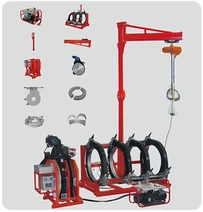
Products Description
Our Welding Machine HDPE Pipe Welder is a professional thermoplastic pipe connection device designed specifically for the butt fusion welding of HDPE, PP, PPR, PVDF, and other plastic pipes and fittings. By heating the pipe ends to a specified temperature, the two pipe sections are molecularly fused to form a high-strength, leak-free integral pipe joint, widely used in municipal engineering, petrochemicals, natural gas transmission, water supply and drainage, and agricultural irrigation.

Product Details
|
Hydraulic Butt Fusion Machine SDD450 200MM-450MM (8" IPS -18'' IPS)
|
|||
|
WELDING RANGE O.D.
|
200MM - 450MM
|
PISTON AREA
|
22.37cm²
|
|
POWER SUPPLY
|
380V±110%, 50/60HZ
|
TEMPERATURE RANGE
|
MAX. 320ºC
|
|
HEATER POWER
|
5.38KW
|
PACKING DIMENSION
|
1300*840*840 MM
|
|
TRIMMER POWER
|
1.5KW
|
820*600*1100 MM
|
|
|
PUMP POWER
|
1.5KW
|
710*340*400 MM
|
|
|
WORKING PRESSURE RANGE
|
0 - 120 BAR
|
GROSS WEIGHT
|
493KGS
|

Product Features
1. High-precision temperature control: Independent temperature control system ensures uniform heating plate temperature with deviation controlled within ±5°C, guaranteeing stable welding quality.
2. Non-stick coating: Heating plate uses Daikin/PTFE Teflon coating to prevent molten plastic adhesion and facilitate cleaning.
3. Low starting pressure: Ensures reliable welding quality for small-diameter pipes.
4. Digital monitoring: Shockproof pressure gauge + digital temperature controller + independent timer, recording heat absorption and cooling time in real time.
5. Modular design: Detachable clamps facilitate welding of special pipe fittings such as tees and elbows, and are also suitable for trench work.
6. Safety design: Explosion-proof industrial socket, overheat protection, and emergency stop button.
Application Areas
1. Municipal Engineering: Water supply and sewage pipelines
2. Gas Transmission: Natural gas and coal gas pipelines
3. Agricultural Irrigation: PE irrigation main pipelines
4. Chemical Industry: Corrosion-resistant chemical transmission pipelines
5. Mining Engineering: Slurry transmission pipelines
6. Power and Telecommunications: Cable protection conduits

Common Welding Problems and Solutions
Virtual Welding and Weak Joint Strength: Most of the reason is that the oxide layer on the surface of the pipe is not completely removed. It is recommended to use a special scraper to polish 0.1-0.2mm of the surface layer before welding to expose the fresh HDPE material.
Excessive Material Extrusion at the Joint: The welding pressure is too high, which causes a large amount of molten material to be squeezed out, resulting in insufficient fusion of the actual joint surface. The pressure value should be adjusted according to the pipe diameter and wall thickness in time.
Deformation of the Pipe Fitting after Welding: The heating time is too long or the temperature is too high, which causes the HDPE material to degrade. The welding temperature should be controlled below 240℃, and the heating time should not be blindly extended.
Ununiform Edge Overflow after Welding: The alignment accuracy of the two pipes is not enough, and the fixture should be readjusted to ensure that the center lines of the two pipes are completely coincident.
Daily Maintenance Tips
Standard maintenance can effectively extend the service life of the HDPE pipe welder and maintain stable welding performance:
- Clean the heating plate surface after each use to remove residual plastic melts, keep the Teflon coating intact, and avoid affecting welding flatness.
- Regularly lubricate the guide rail and hydraulic system to ensure flexible clamping and stable pressure output.
- Store the equipment in a dry and ventilated environment to avoid long-term humidity causing rust and circuit aging.
- Regularly calibrate temperature and pressure parameters to ensure welding accuracy and meet engineering standards.
- Check circuit and power accessories regularly to eliminate potential safety hazards before construction.
FAQ
Q: What is the difference between butt fusion and electrofusion welding?
A: Butt fusion joins pipe ends directly using a heated plate, ideal for large diameters and straight runs. Electrofusion uses fittings with embedded heating coils, better for repairs, branches, and confined spaces.
Q: How long does an HDPE fusion weld take to cool?
A: Cooling time depends on pipe diameter and wall thickness. For 63mm pipe, approximately 4-6 minutes; for 315mm pipe, 15-25 minutes. Never disturb the joint during cooling.
Q: Can HDPE pipes of different SDR (Standard Dimension Ratio) be welded together?
A: Yes, but only using electrofusion fittings designed for transitioning between different wall thicknesses. Butt fusion requires matching SDR ratings.
Q: What is the lifespan of an HDPE fusion joint?
A: Properly executed fusion joints have the same design lifespan as the pipe itself-typically 50-100 years depending on application and environmental conditions.
Q: Why is my butt fusion joint showing cold welds?
A: Cold welds result from insufficient heating time, low temperature, or premature pressure application. Always follow the manufacturer's fusion parameters chart for your specific pipe specification.
Q: Are Chinese-made HDPE welding machines reliable?
A: Many Chinese manufacturers produce CE-certified equipment meeting international standards. Key is verifying certification documents, requesting factory audits, and checking reference projects.
Hot Tags: welding machine hdpe pipe welder, suppliers, manufacturers, customized, wholesale, discount, quotation, bulk, in stock, HDPE Butt Fusion Welding, Pipe Fusion Machine, HDPE PIPE Hydraulic Butt Fusion Welding Machine, Butt Fusion Pipe Welding Machine, HDPE Plastic Pipe Welding Machine, Butt Fusion Plastic Pipe Welding Machine