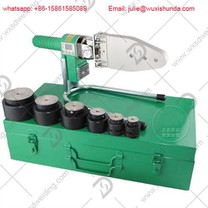
1. Welding preparation
Choose a welding machine: According to the specifications and materials of the plastic pipes and fittings to be welded, select an Electrofusion welding machine of appropriate model and power.
Inspect the equipment: Check whether the appearance of the welding machine is damaged, whether the components are firmly connected, and whether the cables are damaged. After turning on the power, check whether the display and control functions of the welding machine are normal.
Cleaning pipes and fittings: Use a clean cloth or sandpaper to clean the welding surface of the pipes and fittings, remove impurities such as oil, water stains, dust and oxide layer, and ensure that the welding surface is clean, dry and free of debris.
2. Install pipe fittings and connect the welding machine
Insert pipes: Insert the pipes into the electrofusion fittings, ensure that the insertion depth meets the specifications of the fittings, and keep the axis of the pipes and fittings coincident to ensure uniform welding.
Connect the welding machine: Correctly connect the output cable of the welding machine to the electrode on the electrofusion fittings to ensure a tight connection to prevent poor welding caused by virtual connection.
3. Set welding parameters
Get parameters: Check the product manuals of pipes and fittings to get the recommended welding voltage, current, time and other parameters. These parameters usually vary according to factors such as the material, wall thickness, diameter and ambient temperature of the pipe.
Input parameters: Set according to the obtained parameters on the operation interface of the Electrofusion welding machine. Some advanced welding machines may also have the function of automatically identifying the type of pipe fittings and matching the corresponding parameters, but it is still necessary to manually confirm whether the parameters are accurate.
4. Perform welding
Start welding: After confirming that the parameter settings are correct, press the start button of the welding machine to start welding. During the welding process, the welding machine will output current to the resistance wire in the pipe fitting according to the set parameters, so that the resistance wire heats up and melts the contact surface between the pipe fitting and the pipe.
Monitoring process: Pay close attention to the display screen of the welding machine to observe whether the welding current and voltage are stable within the set value range, as well as the countdown of the welding time. At the same time, pay attention to observe whether there are any abnormal phenomena on the surface of the pipe fitting, such as smoke, bulging, etc. If any abnormality is found, press the stop button immediately, cut off the power supply, and check the cause.
5. Welding and cooling
Welding is finished: When the welding time reaches the set value, the welder automatically stops outputting current and the welding is completed. At this time, do not move or touch the welding part immediately to avoid affecting the welding quality.
Natural cooling: Let the welding part cool in a natural environment. The cooling time depends on the specifications of the pipe and fittings, and generally takes 5-15 minutes. During the cooling process, the plastic at the welding point will gradually solidify to form a strong connection.