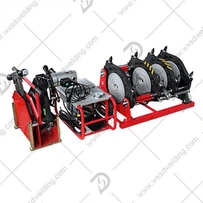
An HDPE pipe butt fusion joint machine (also known as an HDPE butt fusion welding machine, polyethylene pipe welding machine, or HDPE pipe jointing machine) is specialized equipment designed to create permanent, leak-proof joints between high-density polyethylene (HDPE) pipes and fittings. The butt fusion process heats the pipe ends to their melting point (typically 200–220°C) and presses them together under controlled pressure, resulting in a molecular-level bond that is as strong as the pipe itself.

Step-by-Step Operation Checklist
Step 1 – Preparation
✔ Clean pipe ends (no dirt, oil, moisture)
✔ Confirm pipe material (PE4710, PE100, etc.) and SDR
Step 2 – Clamping
✔ Insert pipes into the machine – leave enough "pull-out" for facing
✔ Tighten clamps symmetrically
Step 3 – Facing
✔ Insert facing tool, run until continuous chips form
✔ Remove tool, do not touch faced surfaces
Step 4 – Alignment Check
✔ Bring ends together – max allowed gap: 0.5mm (0.020") for <16", 1mm for larger
✔ Angular misalignment <10% of wall thickness
Step 5 – Heating
✔ Insert heater at correct temperature (typically 400–450°F / 204–232°C)
✔ Apply specific heating pressure (approx. 0.15 N/mm² for PE100)
✔ Observe "bead-up" – time depends on pipe OD and wall thickness
Step 6 – Changeover & Joining
✔ Quickly remove heater (recommended <5 seconds)
✔ Bring ends together at joining pressure (≈0.2–0.3 N/mm²)
Step 7 – Cooling (Under Pressure)
✔ Maintain joining pressure without movement
✔ Cool according to chart (minimum 1 min per mm of wall thickness)
Step 8 – Inspection
✔ Check bead symmetry – a rolled or missing bead indicates misalignment or low pressure
✔ No voids, cracks, or discoloration
Key Components of an HDPE Pipe Butt Fusion Welding Machine
1. Hydraulic Power Unit
Provides controlled fusion pressure for consistent welding results.
2. Machine Frame
Supports and aligns pipes during the welding process.
3. Facing Tool
Ensures pipe ends are perfectly flat and ready for fusion.
4. Heating Plate
Delivers uniform heat to soften HDPE material.
5. Control System
Monitors temperature, pressure, and welding parameters.
6. Data Logger (Optional)
Records welding data for quality control and project documentation.
Advantage
1. Superior Joint Strength
Butt fusion joints create a continuous pipeline with no weak connection points.
2. Leak-Free Performance
Properly fused HDPE joints eliminate leakage risks common in mechanical connections.
3. Long Service Life
HDPE fusion joints can last over 50 years under normal operating conditions.
4. Corrosion Resistance
Unlike metal pipelines, HDPE systems resist rust, corrosion, and chemical degradation.
5. Cost Efficiency
Reduced maintenance and fewer fittings lower overall project costs.
6. Environmental Safety
Fusion welding requires no solvents or chemicals, making it environmentally friendly.
Applications
1. Municipal Water Networks
HDPE pipelines are widely used for potable water distribution because of their durability and safety.
2. Natural Gas Distribution
Leak-free butt fusion joints make HDPE ideal for gas transportation systems.
3. Mining Industry
HDPE pipes withstand abrasive materials and harsh operating environments.
4. Agricultural Irrigation
Large-scale irrigation projects benefit from HDPE's flexibility and long service life.
5. Industrial Processing
Chemical plants and manufacturing facilities use HDPE pipelines for transporting liquids and gases.
FAQ
Q: What is the difference between butt fusion and electrofusion?
A: Butt fusion joins pipe to pipe (or pipe to fitting) by heating entire ends; electrofusion uses a fitting with embedded heating wires. Butt fusion is faster for long pipelines; electrofusion is preferred in tight spaces.
Q: Can you butt fuse different SDRs or materials?
A: No. Both pipes must be the same material (e.g., PE100), same SDR (wall thickness), and same diameter. Fusing different SDRs creates weak spots.
Q: How long does a butt fusion joint take?
A: For 12″ SDR-11 HDPE pipe: approx. 2 minutes heating, 12 minutes cooling – total ~14 minutes per joint (excluding setup).
Hot Tags: hdpe pipe butt fusion joint machine, suppliers, manufacturers, customized, wholesale, discount, quotation, bulk, in stock, Pipe Fusion Machine, Butt Fusion Plastic Pipe Welding Machine, Hydraulic Butt Fusion Pipe Welding Machine, Plastic Pipe Butt Fusion Welding Machine, Joint Pipe Machine, Hydraulic Hdpe Pipe Butt Fusion Welding Machine