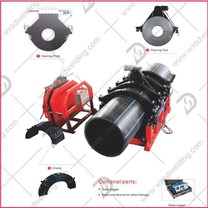
1. Preparation before use
1. Equipment inspection
Appearance inspection: Check whether the outer shell of the electric fusion welding machine is damaged, cracked or deformed. Make sure that the buttons, display screen and other components on the operation panel are intact and there are no signs of looseness or damage.
Power cord inspection: Check whether the power cord is damaged or aged. If the outer skin of the power cord is cracked, worn or the internal wire is exposed, the power cord should be replaced in time to prevent electric shock accidents. At the same time, check whether the power plug can be inserted into the socket normally, and whether the plug pins are bent or corroded.
Output line inspection: The output line of the electric fusion welding machine is used to connect the electric fusion pipe fittings. Check whether the output line is intact and whether the connectors at the end of the line (such as plugs or terminals) are firm, without looseness or oxidation.
Internal circuit inspection (optional): For users with certain maintenance capabilities or regular maintenance, you can open the outer shell of the welding machine (when the power is off and safety is ensured) to check whether the internal electrical components are burnt, smelly, loose or damaged. Mainly check the transformer (if any), rectifier, capacitor, relay and other components.
2. Preparation of working environment
The electric fusion welding machine should be placed in a dry and well-ventilated environment. Avoid using it in humid, waterlogged or dusty places, as moisture and dust may affect the performance of the welding machine and even cause faults such as short circuits.
If used outdoors, avoid the welding machine from rain or direct sunlight. A simple rain shelter or sunshade can be built to protect the welding machine.
Make sure there is enough space in the working area to facilitate the operation of the welding machine and the connection of pipe fittings and pipes, and there are no flammable or explosive items around to prevent dangers such as fire or explosion.
2. Preparation of pipe fittings and pipes
1. Inspection of pipe fittings
Check the specifications of the electric fusion pipe fittings, including whether the parameters such as pipe diameter and wall thickness meet the engineering requirements. Check the appearance of the pipe fittings, and there should be no defects such as cracks, sand holes, scratches, etc.
Check whether the markings on the pipe fittings, such as the model, production batch, rated voltage, welding time, etc. of the pipe fittings are clear and complete. These marking information is very important for setting the welding machine parameters correctly.
Confirm whether the heating wire inside the pipe fitting is intact and there is no open circuit or short circuit. Although the heating wire cannot be seen directly, the state of the heating wire can be preliminarily judged by measuring the resistance between the terminals of the pipe fittings (using a multimeter, the resistance value should be within a reasonable range).
2. Pipe preparation
Select pipes that match the pipe fittings. The material, diameter and wall thickness of the pipes should meet the requirements of the engineering design.
Clean the connection ends of the pipes and remove oil, dust, impurities, etc. on the surface. For polyethylene (PE) pipes, the surface oxide layer should also be removed. You can use a special cleaning tool or sandpaper to gently wipe it to ensure that the connection surface is clean and dry.
Insert the pipe into the pipe fitting to the correct depth according to the requirements of the pipe fitting. Generally, there will be marks on the pipe fittings to indicate the insertion depth. Insufficient insertion depth may lead to insufficient connection strength, and excessive insertion may cause problems such as uneven material extrusion during welding.
III. Welding operation
1. Welding machine connection
Insert the power cord of the electric fusion welder into a suitable power socket (according to the rated input voltage of the welder, such as 220V or 380V), and ensure that the plug is plugged in tightly.
Correctly connect the output line of the electric fusion welder to the terminal or socket of the electric fusion pipe fitting. If it is a terminal type, make sure the connection is firm and the screws are tightened; if it is a socket type, insert the plug to the bottom to prevent loosening.
2. Parameter setting
According to the model, specification and material of the pipe marked on the electric fusion pipe fitting, set the appropriate welding parameters on the operation panel of the welding machine.
Mainly set the welding voltage and welding time. These parameters are usually provided by the pipe fitting manufacturer and are set strictly in accordance with the manufacturer's requirements. For example, a certain specification of PE electric fusion pipe fittings may require a welding voltage of 39V and a welding time of 120 seconds.
3. Welding process
After confirming that the parameter settings are correct and the connection is correct, press the "Start" or "Weld" button on the welding machine operation panel to start the welding program.
During the welding process, pay close attention to the operating status of the welding machine. Pay attention to whether the output voltage, current and other parameters displayed on the display of the welding machine are stable, as well as the countdown of the welding time.
If the welding machine is found to be abnormal, such as alarm sound, flashing display or large fluctuations in voltage and current, stop welding immediately and check the cause. Possible reasons include unstable power supply, poor connection between pipe fittings and pipes, welding machine failure, etc.
4. Welding completed
When the welding time countdown ends, the welding machine automatically stops outputting power and the welding process is completed. At this time, do not operate the welding part immediately, and let it cool down naturally.
IV. Cooling and inspection
1. Cooling stage
After welding is completed, keep the pipe fittings and pipes connected and let the welding part cool down naturally. Do not apply external force to the welding part, such as moving, twisting, etc., so as not to affect the welding quality.
The cooling time depends on factors such as the specifications of the pipe fittings, the material of the pipe, and the ambient temperature. Generally speaking, smaller pipe fittings and thin-walled pipes may require 3-5 minutes of cooling time at room temperature, while larger pipe fittings and thick-walled pipes may require 10-15 minutes or even longer.
2. Quality inspection
After cooling, perform an appearance inspection on the welding part. Check whether there are obvious defects in the welding part, such as pores, slag inclusions, and unfused parts.
Check whether the circumference of the welding part is uniform, and there should be no obvious bulges or depressions. If any suspected welding quality problems are found, non-destructive testing methods (such as ultrasonic testing, X-ray testing, etc., for application scenarios with higher requirements) can be used for further inspection.
Wuxi Shunda Plastic Pipes Welding Machine Co., Ltd
+86-510-83292458
 Language
- English
- O'zbek
- Čeština
- Srbija jezik (latinica)
- slovenščina
- عربي
- Malti
- Français
- dansk
- українська
- Bai Miaowen
- suomi
- Việt Nam
- Svenska
- Türkçe
- Gaeilgenah Éireann
- 日本語
- Ελληνικά
- slovenčina
- ไทย
- Cymraeg
- Català
- русский
- magyar
- hrvatski
- România limbi
- Italiano
- বাংলা
- עברית
- فارسی
- Deutsch
- 한국어
- íslenska
- اردو
- Kreyòl Ayisyen
- Indonesia
- Português
- bosanski
- Melayu
- Nederlands
- Norsk
- हिंदी
- Eesti
- Lietuvių
- Latviešu
- Español
- Български
- Polski