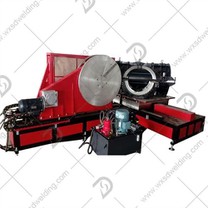
I. Equipment Classification and Applicable Scenarios
1. Electric Fusion Welder
Suitable for small-diameter pipes (20-630mm) and complex environments, it welds pipes by heating the embedded heating wire with an electric heating element.
Advantages: Automatically recognizes pipe barcode parameters, easy to operate, and suitable for demanding projects such as gas and water supply.
2. Butt Fusion Welder
Suitable for large-diameter pipes (63-1000mm), it welds the pipe ends together using a heating plate and then pressurizes them.
Fully automatic models feature programmable temperature and pressure control, resulting in more consistent welding quality.
II. Standard Operating Procedures
(I) Preparation
1. Equipment Inspection
Confirm that the power cord, plug, and control panel are intact and that the voltage is correct (220V/380V).
Test the hydraulic system pressure (0.15-0.2MPa) and the heating plate temperature (200-230°C).
2. Pipe Preparation
Use a milling cutter to flush the pipe end and remove any oil or oxide (wipe with alcohol).
Mark the insertion depth (for electric fusion fittings) or allow 20-30mm of extension (for butt fusion).
(II) Welding Execution
1. Electric Fusion Welder Operation
Scan the pipe fitting. The barcode automatically sets parameters (temperature 200-240°C, time calculated based on wall thickness).
Keep the pipe stable and avoid movement during heating.
2. Butt-fusion operation
Heating plate temperature 210 ± 10°C, heat absorption time = wall thickness x 10 seconds.
After the flange height reaches the specified value, reduce the pressure to 0.02 MPa and complete the butt-fusion within 5 seconds.
(III) Cooling and Testing
Naturally cool to room temperature (electric fusion takes several minutes, hot fusion takes over 10 minutes).
Inspect the weld uniformity and perform a pressure test (hold pressure at 0.15 MPa for 10 minutes).
III. Key Considerations
1. Environmental Requirements
If the temperature is below 5°C, an insulated shed must be erected to avoid operations in rainy or snowy weather.
2. Parameter Control
The heating plate temperature must not exceed 230°C (to prevent carbonization).
Misalignment must be less than 10% of the pipe wall thickness.
3. Safety Precautions
Wear heat-resistant gloves and goggles. Do not touch the heating plate.
Re-electrofusion welding is prohibited on vented pipes (explosion-proof).
IV. Troubleshooting
Uneven flanging: Re-mill the pipe end and adjust the pressure.
Weld bubbles: Check pipe cleanliness and heating time.