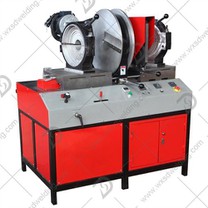
1. Preliminary preparation:
1. Personnel training: Ensure that the operator has received professional training and is familiar with the operating procedures, safety precautions and emergency treatment methods of the automatic tube welding machine. Only after passing the assessment can they go to work.
2. Wear protective equipment: Operators must wear designated safety equipment, such as protective shoes, protective gloves, protective glasses, earplugs, etc., to prevent electric shock, burns, arc eye injuries, dust inhalation and mechanical damage, etc.
3. Check the equipment and environment:
Confirm the safety of the equipment, check whether the power cord and other electrical plugs are intact, and do not forcefully squeeze or pull the power cord and electrical plug during use; check the safety vents to ensure that they are in a well-ventilated state. If the vents are blocked, they should be cleaned in time to avoid fire or other dangerous accidents due to poor heat dissipation of the equipment.
Check the welding head and jaws. The electrodes, jaws and welding heads must be carefully checked before work. If there is any damage or incompleteness, they must be replaced or repaired.
Check the material and specifications of the workpiece to avoid dangerous situations caused by the quality or specifications of the workpiece not meeting the requirements.
Ensure that the working area is clean and tidy, avoid fire sources and flammable items, and ensure that other equipment and personnel will not be disturbed or injured during operation.
The welding machine should be installed in a stable, dry place without obvious vibration. It is forbidden to use it in a humid, flammable or corrosive gas environment.
2. During operation:
1. Hoisting and placement: When hoisting or moving the welding pipe section to the roller of the pipeline automatic welding machine, be careful not to hit the pipeline automatic welding machine and place it lightly on the roller; the placement position and height of the supporting trolley of the pipeline automatic welding machine must ensure that the welding workpiece is in a horizontal position; the welding workpiece should be placed on the corresponding roller group according to its pipe diameter.
2. Cross arm operation: Confirm that the cross arm locking mechanism is in the open state before the cross arm is allowed to be raised and lowered; it is strictly forbidden to directly press the welding workpiece by lifting the cross arm motor. After the clamping wheel contacts the workpiece, it should be pressed manually.
3. Welding parameter setting: Welding should be carried out strictly in accordance with the requirements of the welding process assessment guide. Welders of each layer should keep track of the welding parameters of this layer at any time, such as current, voltage, etc.; do not change the voltage debugging switch at will during welding.
4. Welding operation:
Workers must not leave the operating position or keep a distance from the welding object. If the welding object needs to be repositioned, the operator should turn off the automatic pipe welding machine before repositioning and operating.
Pay attention to the welding process. If arc deviation, excessive spatter, abnormal sound, etc. are found, welding should be stopped immediately, the cause should be found out and countermeasures should be taken.
It is strictly forbidden to clean up debris, long hair, cloth strips, etc. on the roller without stopping the machine to avoid danger; before cleaning up the debris on the main machine base platform, be sure to confirm that the roller has stopped rotating.
During welding, live parts such as the welding machine output interface must not be touched; when changing or debugging the panel knob, do not use excessive force to avoid damaging the equipment.
The radius of the wire feeding hose should not be less than 150mm, otherwise the internal cable may be damaged, resulting in an accident; the welding gun cable should not be pressed too tightly, and the bending angle should not be too small.
5. Gas protection: If it is gas shielded welding, ensure that the shielding gas system works normally, check the shielding gas circuit and gas meter for leaks at any time, and ensure that the gas flow is stable.
6. Grounding safety: Ensure that the grounding wire is in good contact; multiple welding machines must not be grounded in series; the grounding electrode must be in good contact, and copper pipes or seamless steel pipes can be used. The copper pipe and seamless steel pipe are buried underground at a depth greater than 1 meter, and the grounding electrode resistance value must not exceed 4 ohms. The grounding device can use natural grounding electrodes, such as metal structures of buildings with reliable grounding to the earth, pipelines laid underground, etc., but it is strictly forbidden to use oxygen, acetylene, gas and other flammable and explosive gas pipelines as grounding electrodes.
3. After welding is completed:
1. Turn off the power: After work every day, the main power supply of the pipeline automatic welding machine must be turned off.
2. Clean the work area: Clean up discarded welding wires, weldment residues and other debris in time to keep the work area clean; regularly clean the dust inside and outside the pipeline automatic welding machine to ensure that the equipment is in good working condition.
3. Equipment maintenance and care: Regularly check and maintain the equipment, including checking the gearbox, roller group, column screw and cross arm lifting slideway lubricating oil and adding it in time, regularly cleaning and replacing the conductive nozzle, nozzle, flow divider, wire feeding tube, wire feeding wheel, welding torch (gun) and other consumable parts.
4. Workpiece processing: If the pipe mouth of the welded pipe section is not to be welded on the same day, it must be temporarily blocked when the work break exceeds 2 hours; for some welded parts with special requirements, corresponding post-processing measures must be taken, such as heat treatment, non-destructive testing, etc.
Wuxi Shunda Plastic Pipes Welding Machine Co., Ltd
+86-510-83292458
 Language
- English
- O'zbek
- Čeština
- Srbija jezik (latinica)
- slovenščina
- عربي
- Malti
- Français
- dansk
- українська
- Bai Miaowen
- suomi
- Việt Nam
- Svenska
- Türkçe
- Gaeilgenah Éireann
- 日本語
- Ελληνικά
- slovenčina
- ไทย
- Cymraeg
- Català
- русский
- magyar
- hrvatski
- România limbi
- Italiano
- বাংলা
- עברית
- فارسی
- Deutsch
- 한국어
- íslenska
- اردو
- Kreyòl Ayisyen
- Indonesia
- Português
- bosanski
- Melayu
- Nederlands
- Norsk
- हिंदी
- Eesti
- Lietuvių
- Latviešu
- Español
- Български
- Polski