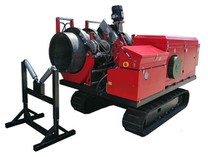
1. Preparation before welding
1. Equipment inspection
Check whether the power cord of the butt welding machine is connected correctly and without damage, ensure good grounding, and prevent electric shock accidents.
Check whether the temperature sensor and heating wire of the heating plate are working properly. A preliminary inspection can be carried out through the detection function of the equipment itself or simple resistance measurement.
Check the hydraulic or mechanical pressure system. For the hydraulic system, check whether the hydraulic oil level is appropriate and whether there is any leakage; for the mechanical system, check whether the screw, nut and other components can operate normally.
Check the milling cutter device to ensure that the milling cutter is sharp and the motor can start and rotate normally.
2. Preparation of pipes and fittings
According to the welding requirements, select PE pipes or fittings of appropriate diameter.
Clean the welding parts of the pipes or fittings to remove impurities such as dirt, oil, oxide layer, etc. on the surface. You can use a special cleaner and a clean cloth to wipe it.
3. Installation and adjustment of fixtures
According to the diameter of the pipe or fittings, select and install the appropriate fixture on the butt welding machine.
Adjust the spacing and clamping force of the clamps to ensure that the pipe or pipe fitting can be firmly clamped and that the pipe or pipe fitting is in a coaxial state during the welding process.
2. Welding operation process
1. Milling the connection surface
Start the milling cutter device and place the connection end of the pipe or pipe fitting under the milling cutter head.
Slowly move the pipe or pipe fitting so that the milling cutter evenly mills the connection surface. The milling depth should be adjusted according to the wall thickness of the pipe or pipe fitting. Generally, it is for the purpose of removing surface impurities and ensuring the flatness of the connection surface. Usually, the thickness of the connection surface after milling should be uniform and there should be no obvious knife marks or defects.
After milling, turn off the milling cutter device and clean up the debris generated by milling.
2. Heating operation
Set the heating temperature of the heating plate (generally between 200-230°C) according to factors such as the type of PE material, the wall thickness of the pipe or pipe fitting, and the ambient temperature.
Fit the connection surface of the pipe or pipe fitting tightly to the heating plate respectively, ensure good contact, and start heating.
During the heating process, pay close attention to the temperature display of the heating plate to ensure that the temperature fluctuates within the set range. At the same time, set the heating time according to the wall thickness of the pipe or fitting. When the wall thickness is thicker, the heating time should be appropriately extended.
3. Docking and pressing
When the heating time reaches the set value, quickly remove the heating plate.
Immediately dock the two connecting surfaces of the pipe or fitting accurately together. The operation should be quick and smooth to prevent the connecting surface from cooling too quickly and affecting the welding quality.
Start the hydraulic or mechanical pressure system and apply pressure to the docking part according to the specified pressure value. During the pressure application process, ensure that the connecting part of the pipe or fitting is stable without displacement or deformation. The pressure application time also needs to be set according to the specifications of the pipe or fitting.
4. Cooling stage
After the pressure application time is over, maintain a certain pressure and let the connection part cool naturally.
During the cooling process, the clamp should not be loosened too early or external force should be applied to the connection part. The cooling time should be determined according to factors such as the specifications of the pipe or fitting and the ambient temperature. It usually takes several minutes to more than ten minutes until the connection part is completely cooled and the welding is completed.
3. Inspection after welding
1. Appearance inspection
Check the appearance of the welded part to see if there are obvious defects, such as uneven welds, pores, slag inclusions, etc.
Check whether the circumference of the welded part is uniform and whether there is any deviation.
2. Pressure test (according to the application scenario)
In some application scenarios with high pressure requirements, such as gas transmission or water supply and drainage main pipelines, it is necessary to perform pressure testing on the welded pipes.
By filling the pipeline with a certain pressure medium (such as air, water, etc.), check whether the welded part can withstand the specified pressure without leakage and other problems.
Wuxi Shunda Plastic Pipes Welding Machine Co., Ltd
+86-510-83292458
 Language
- English
- O'zbek
- Čeština
- Srbija jezik (latinica)
- slovenščina
- عربي
- Malti
- Français
- dansk
- українська
- Bai Miaowen
- suomi
- Việt Nam
- Svenska
- Türkçe
- Gaeilgenah Éireann
- 日本語
- Ελληνικά
- slovenčina
- ไทย
- Cymraeg
- Català
- русский
- magyar
- hrvatski
- România limbi
- Italiano
- বাংলা
- עברית
- فارسی
- Deutsch
- 한국어
- íslenska
- اردو
- Kreyòl Ayisyen
- Indonesia
- Português
- bosanski
- Melayu
- Nederlands
- Norsk
- हिंदी
- Eesti
- Lietuvių
- Latviešu
- Español
- Български
- Polski