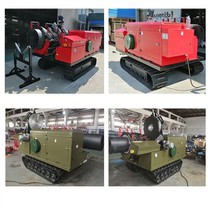
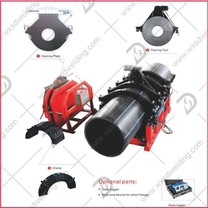
The fully automatic welding machine is designed for welding boilers and heat exchanger products in the chemical industry. It mainly includes power supply (including control system and water cooling system), machine head and welding operation frame; fully automatic welding machine can be used according to customer's welding process requirements. The core design of self-fusing/welding wire, DC/pulse welding, and non-winding hydropower can realize the complex process requirements of single pass and multi pass; core center positioning and welding operation frame positioning are two methods, according to different tubes Choose different positioning methods, the design is more reasonable and humane. The welding system of the automatic welding machine is highly integrated, and the operation is stable and reliable. There is also a self-dissolving type, usually welded with thin-walled tubes, such as stainless steel tubes or titanium tubes used in power plant condensers. Of course, it can also be used in the heat exchanger industry.
The working principle of the fully automatic welding machine: The welding principle is between cold pressure welding and friction welding. It uses high-density energy generated by high-frequency mechanical vibration. The mechanical vibration of the welding head of ultrasonic metal welding is parallel to the surface of the workpiece. During the welding process, static pressure acts vertically on the welding surface through the welding head, and superimposes the shearing force of high-frequency vibration. When the shear force exceeds the elastic limit of the material, part of the workpiece contact surface begins to slide. During the welding process, the direction of the shear force changes continuously at a frequency of tens of thousands of times per second, and the dirt on the surface of the workpiece is destroyed and removed. The surface of pure metal begins to form multiple points of contact. As the high-frequency vibration continues, the contact area of pure metal continues to expand until it extends to the entire welding area. At the same time, atoms diffuse on the contact surface, and the metal recrystallizes to produce a fine-grained structure and exhibits the characteristics of cold deformation of the metal.