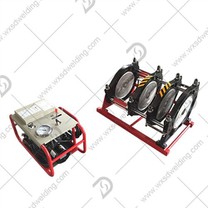
1 Preparation before welding 1. Check the welding input voltage specifications. It is strictly prohibited to connect other levels of voltage to prevent the welding machine from burning out or failing to work.
2. Correctly select the power wiring according to the actual power of the equipment.
3. Measure the power supply voltage to confirm that the voltage meets the requirements when the welding machine is working.
4. Clean the power output connector to ensure good conductivity. 1. Before welding, check whether the welding voltage, time and other melting parameters are consistent with the electrofusion pipe fittings.
2. Marking: Measure the length or center line of the electrofusion pipe, and mark the welded pipe surface with a line.
3. Cut the pipe. The cross section of the pipe should be perpendicular to the axis, and the error should be <5mm.
4. Clean the welding surface. Scrape the welding surface in the marked area about 0.1-0.2mm thick to remove the oxide layer. The scraping area should be larger than the edge of the socket pipe fitting.
5. Socketing of pipes and fittings. Re-mark the pipe at half the length from the section. Socket the clean electrofusion pipe fitting with the pipe to be welded, keeping the outer edge of the pipe fitting flush with the marked line. The misalignment between pipes and fittings should be less than 2%.
6. Pipe fitting installation. Use the instructions provided by the pipe fitting manufacturer to ensure that there is no gap between the two welding surfaces of the pipe fitting and the pipe.
7 Welding Start the welding switch and set the welding time according to the time specified in the pipe fitting product manual. 1. The connection between the welding plug and the electrofusion pipe fitting must be firm and must not be loose.
8 Natural cooling The cooling time should be determined according to the product instructions of the pipe fittings. During the cooling process, no external force should be applied to the welded parts.
Wuxi Shunda Plastic Pipes Welding Machine Co., Ltd
+86-510-83292458
 Language
- English
- O'zbek
- Čeština
- Srbija jezik (latinica)
- slovenščina
- عربي
- Malti
- Français
- dansk
- українська
- Bai Miaowen
- suomi
- Việt Nam
- Svenska
- Türkçe
- Gaeilgenah Éireann
- 日本語
- Ελληνικά
- slovenčina
- ไทย
- Cymraeg
- Català
- русский
- magyar
- hrvatski
- România limbi
- Italiano
- বাংলা
- עברית
- فارسی
- Deutsch
- 한국어
- íslenska
- اردو
- Kreyòl Ayisyen
- Indonesia
- Português
- bosanski
- Melayu
- Nederlands
- Norsk
- हिंदी
- Eesti
- Lietuvių
- Latviešu
- Español
- Български
- Polski