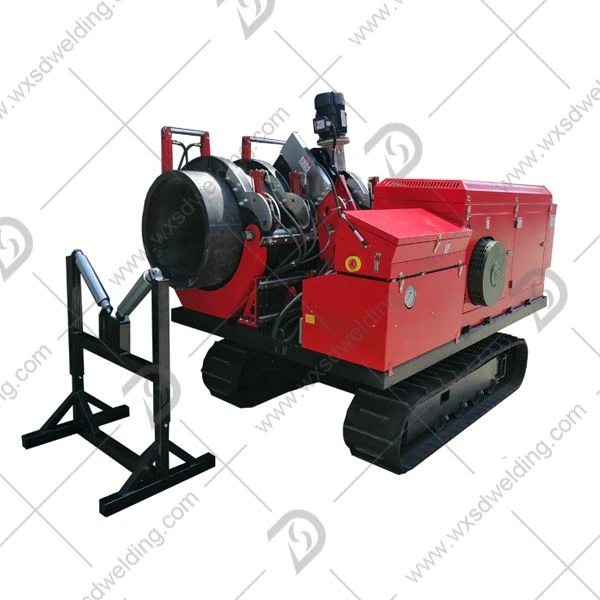
Operating Steps:
1. Inspection and Preparation: Confirm that the welding machine's power supply voltage (usually 220V) matches the nameplate. Check the cable and welding torch for damage. Select the appropriate welding machine model based on the pipe material (e.g., PE, PPR) and pipe diameter (e.g., 63-110mm).
2. Parameter Setting: Refer to the welding machine's instruction manual or pipe specifications to set appropriate temperature (e.g., 200-230℃ for PE pipes), pressure (e.g., 0-10MPa), and welding time. For example, a fully automatic welding machine can be set with a pressure accuracy of 0.1MPa and a time resolution of 0.1S.
3. Welding Operation: Insert the pipe and fitting into the socket, ensuring the insertion depth (usually 1.5 times the pipe diameter) and root clearance (1.6-3.2mm). Start the welding machine and move it at a uniform speed to avoid welding defects.
4. Post-Welding Treatment: After welding, slowly remove the welding machine and allow the weld to cool naturally. Clean up welding slag and spatter, and check if the weld is continuous and uniform.
Safety Precautions:
1. The welding machine casing must be reliably grounded to prevent electric leakage.
2. Harmful gases are generated during welding; ensure good ventilation.
3. Always disconnect the power supply when moving the welding machine; do not drag the cable.
4. Avoid overloading the welding machine; carefully monitor the temperature rise.
Common Problem Troubleshooting:
1. If the welding machine cannot start, check the power connection, fuse, and control circuit.
2. If the weld quality is poor, check the parameter settings, pipe cleanliness, and operating technique.