


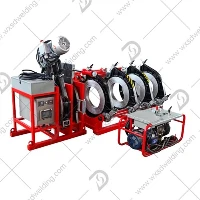
As a supplier of PE butt welding machines, I get this question all the time: Can a PE Butt Welding Machine actually be used for welding high-density polyethylene (HDPE) pipes? It's a fair one-when you're sourcing equipment for a project, you want to make sure your gear aligns with the material you're working with, especially since HDPE is such a staple in water supply, gas distribution, sewage, and industrial piping systems. Let me break this down from real-world field experience, material science, and what our machines are built to do, so you don't have to second-guess this match.
First, let's start with the basics: what HDPE is, and how butt fusion welding works. HDPE is a thermoplastic polymer, meaning it softens when heated and hardens again as it cools-perfect for fusion welding, since you can melt the ends of two pipes, press them together, and create a joint that's as strong (or stronger) than the pipe itself. A PE butt welding machine is designed to execute exactly that process: it clamps two pipe ends, mills the faces flat, heats them to the specific melting temperature of HDPE, removes the heater plate, and applies controlled pressure to fuse the pipes together.
Wait, but is there a difference between "PE" and "HDPE" machines? The short answer is no, not when it comes to core functionality. Most PE butt welding machines are calibrated for HDPE's unique thermal properties. HDPE has a melting point between 120°C and 140°C (248°F to 284°F), a low coefficient of friction, and it's resistant to stress cracking-all factors that a good PE butt welding machine is built to accommodate. For example, our Pe Butt Welding Machine comes with adjustable pressure controls that account for HDPE's tendency to deform if too much pressure is applied while molten, plus integrated heaters that maintain a consistent temperature across the pipe's entire cross-section, so you don't get weak spots from uneven heating.


I've seen this play out on job sites firsthand. Last year, a municipal water department was working on a 12,000-foot water main replacement using 8-inch HDPE pipes, and they initially tried to rent a generic welder that wasn't calibrated for HDPE. Their first three joints failed pressure tests within a week-turns out the machine's heater plate was too large, so the outer edges of the pipe heated faster than the center, leading to uneven fusion. Once they switched to our Pe Butt Welding Machine, which has a tailored heater plate and pressure tracking system, their joint success rate jumped to 98%, and they passed the pressure test on the first try. That's the kind of reliability that comes from equipment built specifically for HDPE, not just general "plastic welding."
Of course, there are nuances to consider when using a PE butt welding machine for HDPE-size is a big one. HDPE pipes come in a range of diameters, from small 16mm (for irrigation) up to 1200mm (for large-scale water systems). Our Manual HDPE Pipe Jointing Machine, for example, is designed for smaller to mid-sized pipes (up to 160mm), while our motorized units handle larger diameters. No matter the size, the key steps of butt fusion remain the same: proper milling, correct heat time, and controlled pressure during the cooling phase. Skipping any of these, even with the right machine, will lead to bad joints-but use a PE butt welding machine as intended, and HDPE joints will hold up for decades.
Another common question: can I use a PE butt welding machine for HDPE fittings, too? The answer is yes, though you might want a specialized machine for fittings. Our Hdpe Pipe Fitting Fusion Welding Machine is built to handle the irregular shape of HDPE fittings (elbows, tees, reducers) that standard straight pipes, ensuring a uniform melt on both the pipe end and the fitting's socket. That said, a well-calibrated PE butt welding machine can work for basic fitting connections if the fitting's end is compatible with the machine's clamping system-just make sure you verify the fitting's dimensions before trying to pair them.
I've also heard folks confuse manual vs. motorized PE butt welding machines for HDPE projects, and both have their place. For small, low-volume jobs, like residential irrigation or small commercial plumbing, our Manual Butt Fusion Pipe Welding Machine or Manual Butt Fusion Welding Machine are perfect. They're lightweight, easy to transport to tight job sites, and give you full control over pressure for small-diameter HDPE pipes. For large, high-volume municipal or industrial projects, motorized PE butt welding machines are better-they automate pressure and heat time, reducing human error and speeding up production. Either way, both are designed for HDPE; you're just choosing based on job scope, not material compatibility.
Let's address a common misconception: some people think PE butt welding machines can only work with "virgin" HDPE, not recycled HDPE. That's not true, as long as the machine's heat settings are adjusted for the recycled material's melt flow index. Recycled HDPE has a slightly different molecular structure, so it requires a slightly longer heat time-but our machines have adjustable heat timers that let you calibrate for any HDPE type, virgin or recycled. I worked with a recycling plant a few months back that was using recycled HDPE to make drainage pipes, and they switched to our PE butt welding machine after their old machine couldn't handle the recycled material's higher melt temperature. They've since produced over 50,000 feet of drainage pipe with zero joint failures, which is a testament to how flexible these machines can be.
So, to circle back to the original question: Yes, a PE butt welding machine is absolutely suitable for welding HDPE pipes-when it's the right model, calibrated correctly, and used following industry-standard procedures. The key is choosing a machine built for HDPE's specific thermal and mechanical properties, not a generic plastic welder that can't maintain consistent temperature or pressure. Whether you're working on a small residential project or a large municipal pipeline, our range of PE butt welding machines (including manual units for smaller jobs and motorized models for larger operations) are designed to meet those needs.
If you're in the market for a machine to handle your HDPE welding projects, feel free to reach out to discuss your specific requirements-we can help you select the right machine, whether it's the Manual HDPE Pipe Jointing Machine for small diameters, the Pe Butt Welding Machine for standard projects, or the Hdpe Pipe Fitting Fusion Welding Machine for specialized fittings. We also offer training on proper fusion techniques to make sure you get the most out of your equipment, so your joints are strong, long-lasting, and code-compliant.