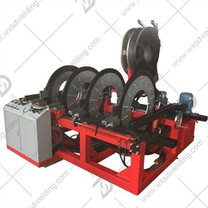
1. Preparation before welding
Check the equipment:
Check whether the appearance of the electric fusion welding machine is damaged, such as whether the shell has cracks, whether the display screen is intact, etc.
Check whether the power cord is intact and the plug is normal to ensure that the equipment can be powered on normally. At the same time, check whether the connecting cable is damaged, short-circuited, etc., and whether the plug and socket of the cable can be tightly connected.
Turn on the electric fusion welding machine and check whether the self-test function of the equipment is normal, including whether the parameters on the display screen are accurate, whether the indicator light is on normally, etc.
Preparation of pipes and fittings:
Check whether the materials of PE pipes and fittings meet the requirements, ensure that they match each other and are suitable for electric fusion welding.
Clean the welding parts of pipes and fittings, wipe with special detergent or clean cloth, and remove impurities such as oil, dust, water stains, etc. on the surface. For pipes, make sure that their ends are flat. If necessary, use pipe cutting tools to cut the pipes neatly.
Mark the part where the pipe is inserted into the fitting. The marking depth should meet the requirements of the fitting. Generally, the insertion depth will be marked on the fitting. This depth is very important for ensuring the quality of welding.
2. Welding parameter setting
Get parameters: According to the specifications and models of PE pipes and fittings, find the electric fusion welding parameters provided by the manufacturer. These parameters usually include key information such as welding voltage and welding time. The welding parameters of fittings of different manufacturers and specifications may vary.
Input parameters: Enter the correct welding parameters on the operation panel of the electric fusion welding machine. Be careful when operating to ensure that the input parameters are accurate. Some advanced electric fusion welding machines may have automatic parameter recognition or storage functions, and the welding parameters can be obtained by scanning the barcode on the fitting.
3. Connect pipes and fittings
Insert the cleaned pipe into the fitting slowly and steadily according to the marked depth, ensure that the central axis of the pipe and the fitting are aligned, and avoid twisting or forcible insertion of the pipe during insertion to avoid damaging the heating wire inside the fitting or affecting the welding quality.
4. Start welding
Connect the cable: Correctly insert the connecting cable plug of the electric fusion welder into the terminal on the pipe fitting to ensure a firm connection and avoid looseness or poor contact during welding.
Start welding: After confirming that the connection is correct, press the welding start button of the electric fusion welder, and the equipment starts welding according to the preset parameters. During welding, the display screen of the welder will display the progress of welding, such as welding time, remaining time and other information.
5. Cooling and inspection after welding
Cooling stage: After welding is completed, let the pipes and fittings cool in a natural state. The cooling time depends on the size and wall thickness of the pipe fittings. Generally, there will be a recommended cooling time in the welding parameters. Do not move the pipes and fittings during the cooling process to avoid affecting the welding quality.
Check the welding quality: After cooling is completed, the welding quality can be preliminarily judged by appearance inspection. Check whether there are obvious defects in the welding part, such as poor fusion, pores, cracks, etc. For application scenarios with higher requirements, non-destructive testing methods (such as ultrasonic testing, pressure testing, etc.) can also be used to further check the welding quality.
Wuxi Shunda Plastic Pipes Welding Machine Co., Ltd
+86-510-83292458
 Language
- English
- O'zbek
- Čeština
- Srbija jezik (latinica)
- slovenščina
- عربي
- Malti
- Français
- dansk
- українська
- Bai Miaowen
- suomi
- Việt Nam
- Svenska
- Türkçe
- Gaeilgenah Éireann
- 日本語
- Ελληνικά
- slovenčina
- ไทย
- Cymraeg
- Català
- русский
- magyar
- hrvatski
- România limbi
- Italiano
- বাংলা
- עברית
- فارسی
- Deutsch
- 한국어
- íslenska
- اردو
- Kreyòl Ayisyen
- Indonesia
- Português
- bosanski
- Melayu
- Nederlands
- Norsk
- हिंदी
- Eesti
- Lietuvių
- Latviešu
- Español
- Български
- Polski