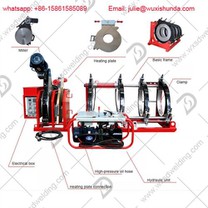
I. Quality Details of Core Components
1. Heating Plate
A qualified heating plate should have a surface flatness ≤0.1mm/100mm, a uniform and flawless PTFE (Teflon) coating, be non-stick, heat up quickly and evenly, with a temperature difference not exceeding ±10℃; for hard chrome stainless steel heating plates, the roughness should be <0.63um for more stable quality.
If the heating plate thickness deviation exceeds the standard, or if the coating has scratches or peeling, it will lead to uneven heating of the weld surface, directly affecting the weld quality.
2. Milling Device (Planker)
Qualification requirements: The blade should have a sharp and flawless cutting edge, be capable of double-sided cutting, and produce a smooth and flat end face of the milled pipe; it should operate without obvious abnormal noise, move smoothly on the frame without jamming; and have a built-in safety limit device to prevent damage to the frame. If the blade is dull or jammed, the milled end face will be uneven, directly causing a weak weld.
3. Hydraulic/Power System: For semi-automatic and higher-level models, the following checks are required: The hydraulic system should have no oil leaks, pressure regulation should be stable, and pressure fluctuations should be minimal during prolonged operation; the motor should operate stably without abnormal noise; and the cylinder should push the pipe without jamming. If the oil pump is weak or the pressure is unstable, it will lead to insufficient welding pressure and substandard weld strength.
II. Inspection of Machining Accuracy and Assembly Process
1. Fixture Coaxiality: After clamping the pipe, the butt joint deviation should be less than 1mm. Excessive deviation can easily cause excessive misalignment, reducing the weld's pressure-bearing capacity. If the deviation still exceeds the standard after adjustment, it indicates that the equipment's factory calibration was unqualified.
2. Temperature Control System Stability: After setting the temperature, observe whether the temperature controller display is stable. If the temperature fluctuates greatly or the deviation exceeds 15℃, it indicates that the temperature controller or sensor is of substandard quality, which can easily lead to insufficient welding temperature or excessive carbonization.
3. Rust Prevention Treatment: Core components such as the frame and clamps should be made of galvanized/chrome-plated/stainless steel, with a burr-free surface and smooth weld seams. Inferior equipment uses ordinary iron plates with paint, which are prone to rust and deformation, affecting accuracy.
III. Verification of Functional Compliance and Brand Qualification
1. Compatibility Verification: The welding range marked on the equipment must cover the pipe specifications you need. For example, if you need to weld DN250-DN630 pipes, the equipment must support the corresponding diameter. Do not choose a smaller model as a "makeshift" solution.
2. Technical Compliance: Reputable products comply with the industry standards for PE pipe welding equipment. Core components (such as temperature controllers and motors) use reliable brands. Prioritize products from manufacturers with welding process qualification certification for better quality assurance.
3. Bonus Features: Models with independent dual-channel timers, real-time recording of welding parameters, and automatic alarms when the timer ends reduce human error and make welding quality more controllable; independent temperature-controlled heating plates offer higher accuracy than uniform temperature control.
IV. Judgment Based on Actual Usage Experience
1. During Trial Run: The machine starts up without any abnormalities, all components operate smoothly, and there are no abnormal vibrations or noises; the manual pushing of the clamps is smooth without jamming, and the hydraulic pushing pressure is stable and adjustable.
2. Test Welding Results: The weld seam is uniformly and symmetrically rolled, without depressions, bubbles, or misalignment. After cooling, the weld seam is flat, indicating that the overall quality of the equipment is qualified. If asymmetrical rolling or excessive misalignment still occurs after multiple test welds, it indicates that the equipment's precision is insufficient.