


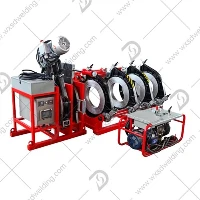
Hey there! As a supplier of Automatic Band Saw Machine, I've been getting a lot of questions about how these machines control speed. So, I thought I'd write this blog to break it down for you.
Why Speed Control Matters
First off, let's talk about why speed control is such a big deal in an automatic band saw machine. Different materials require different cutting speeds. For example, cutting through a soft material like wood is way different from slicing through a tough metal like steel. If you use the wrong speed, you might end up with a rough cut, damage the blade, or even ruin the material you're working on. So, having a good speed control system is crucial for getting the best results.

Variable Frequency Drives (VFDs)
One of the most common speed control methods in modern automatic band saw machines is using Variable Frequency Drives, or VFDs for short. A VFD is like the brain of the speed control system. It works by adjusting the frequency of the electrical power supplied to the motor. When you increase the frequency, the motor spins faster, and when you decrease it, the motor slows down.
The great thing about VFDs is that they offer a wide range of speed adjustment. You can set the speed precisely according to the material you're cutting. For instance, if you're cutting a thin piece of aluminum, you can set a higher speed for a quicker cut. But if you're dealing with a thick block of stainless steel, you'll want to slow it down to avoid overheating the blade.
Another advantage of VFDs is that they're energy - efficient. They only use the amount of power needed to run the motor at the set speed. This means you can save on electricity bills in the long run. And they also help reduce wear and tear on the motor, which extends its lifespan.
Mechanical Speed Control
Before the widespread use of VFDs, mechanical speed control was the norm. There are a few different ways to do this.
One method is using a pulley system. In a pulley - based speed control, you have different sized pulleys that can be switched to change the speed. By moving a belt from a smaller pulley to a larger one on the motor shaft, you can decrease the speed of the saw blade. And vice versa, moving the belt to a smaller pulley will increase the speed.
Another mechanical option is a gearbox. A gearbox contains a set of gears that can be engaged to change the speed ratio between the motor and the saw blade. Different gear combinations give you different speeds. However, mechanical speed control has its limitations. It usually offers a limited number of speed settings, and changing the speed can be a bit of a hassle compared to using a VFD. You might need to stop the machine, make some physical adjustments, and then start it up again.

Hydraulic Speed Control
Hydraulic speed control is also used in some automatic band saw machines, especially those designed for heavy - duty applications. In a hydraulic system, the speed of the saw blade is controlled by adjusting the flow of hydraulic fluid.
The system has a hydraulic pump that generates pressure and a hydraulic motor that drives the saw blade. By changing the flow rate of the fluid going to the hydraulic motor, you can control its speed. This method is great for applications where you need a lot of torque, like cutting thick and hard materials.
Hydraulic speed control can provide smooth and precise speed changes. It can also handle high loads without overheating. But it does have some drawbacks. Hydraulic systems are more complex and expensive to maintain compared to VFDs or mechanical systems. They also require regular fluid changes and can be prone to leaks if not properly maintained.
Digital Control Systems
With the advancement of technology, many automatic band saw machines now come with digital control systems. These systems use microprocessors to manage the speed control. You can input the desired speed on a digital display, and the system will adjust the motor or hydraulic system accordingly.
Digital control systems offer a high level of accuracy and repeatability. You can save different speed settings for different materials, so you don't have to keep entering the same values every time you change the material you're cutting. They also often come with diagnostic features that can alert you if there's a problem with the speed control system, such as a motor malfunction or a hydraulic leak.
Applications and Speed Selection
Now, let's talk about how to choose the right speed for different applications.
For wood cutting, a relatively high speed is usually appropriate. Wood is a soft material, so a faster - moving blade can make quick and clean cuts. You can typically set the speed between 3,000 and 5,000 feet per minute (FPM) depending on the type of wood and the thickness of the piece.
When it comes to cutting metals, the speed selection is more critical. For aluminum, you can use a speed of around 800 - 1,500 FPM. Steel, on the other hand, requires a much lower speed. For mild steel, a speed of 200 - 300 FPM is common, while for high - strength steels, you might need to go as low as 50 - 100 FPM.
For Polyethylene Pipe Multi Angle Band Saw, the speed depends on the diameter and wall thickness of the pipe. Generally, a speed of 100 - 300 FPM is suitable for most polyethylene pipes.
Conclusion
As you can see, there are several ways to control the speed of an automatic band saw machine, each with its own pros and cons. Whether you're a small - scale workshop or a large industrial facility, choosing the right speed control method is essential for getting the best performance out of your machine.
If you're in the market for an automatic band saw machine or have any questions about speed control, don't hesitate to reach out. We're here to help you find the perfect solution for your cutting needs. Let's have a chat and see how we can make your cutting operations more efficient and productive.
References
- "Industrial Band Saw Handbook"
- "Cutting Technology and Machinery"
- Manufacturer's manuals for automatic band saw machines