


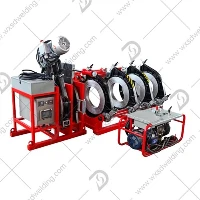
Hey there! As a supplier of CNC saddle welding machines, I often get asked about the maximum welding power output of these nifty machines. So, I thought I'd sit down and write this blog to shed some light on the topic.
First off, let's understand what a CNC saddle welding machine is. It's a high - tech piece of equipment used mainly for welding saddles onto pipes, especially HDPE (High - Density Polyethylene) pipes. These machines are super precise and efficient, thanks to their computer numerical control (CNC) system. They can handle all sorts of welding jobs, from small - scale projects to large industrial ones.
Now, when it comes to the maximum welding power output, it's not a one - size - fits - all answer. There are several factors that can influence this number.
Factors Affecting the Maximum Welding Power Output
1. Machine Design and Build
The design of the CNC saddle welding machine plays a huge role. Some machines are built with more powerful components, like high - performance transformers and advanced welding circuits. These machines can generally deliver a higher welding power output. For example, a well - engineered machine with a solid frame and top - notch electrical components can handle higher currents, which directly translates to more power for welding.
2. Welding Process
Different welding processes require different amounts of power. The most common welding process used in saddle welding is the electro - fusion method. In electro - fusion, an electrical current is passed through a heating element in the saddle fitting, which melts the plastic and creates a strong bond with the pipe. The power needed for this process depends on the size of the saddle and the pipe, as well as the thickness of the plastic. Larger saddles and thicker pipes will require more power to ensure a proper weld.
3. Material of the Pipe and Saddle
The material of the pipe and the saddle also matters. HDPE pipes are widely used in the industry because of their durability and chemical resistance. However, different grades of HDPE have different melting points. Higher - grade HDPE might require more power to melt and weld properly. Similarly, if you're using saddles made from other materials, like polypropylene or PVC, the power requirements will vary.
4. Cooling System
A good cooling system is essential for maintaining the performance of the welding machine. During the welding process, a lot of heat is generated. If the machine doesn't have an effective cooling system, the components can overheat, which can lead to a decrease in power output and even damage to the machine. Machines with efficient cooling fans or water - cooling systems can maintain a stable power output for longer periods.
Typical Maximum Welding Power Output Ranges
Based on my experience as a supplier, the maximum welding power output of CNC saddle welding machines can range from around 1000 watts to 5000 watts.
Smaller machines, which are often used for domestic or small - scale commercial applications, usually have a maximum power output of around 1000 - 2000 watts. These machines are suitable for welding small - diameter pipes and saddles. They're more portable and easier to handle, making them a great choice for DIY projects or small repair jobs.
On the other hand, larger industrial - grade CNC saddle welding machines can have a maximum power output of 3000 - 5000 watts or even more. These machines are designed for heavy - duty applications, like large - scale pipeline construction and infrastructure projects. They can handle big saddles and thick - walled pipes with ease.
Importance of Knowing the Maximum Welding Power Output
Knowing the maximum welding power output of your CNC saddle welding machine is crucial for several reasons.
1. Quality of the Weld
If you don't use enough power, the weld might not be strong enough. The plastic might not melt completely, resulting in a weak bond between the saddle and the pipe. This can lead to leaks and failures in the pipeline system. On the other hand, using too much power can cause the plastic to overheat and burn, which can also affect the quality of the weld.
2. Efficiency
Using the right amount of power can make the welding process more efficient. It reduces the welding time and minimizes the risk of rework. For example, if you're working on a large project, using a machine with the appropriate power output can save you a lot of time and money.


3. Safety
Operating the machine within its maximum power output range is important for safety reasons. Overloading the machine can cause electrical problems, such as short circuits and fires. It can also damage the machine itself, which can be expensive to repair.
Our Range of CNC Saddle Welding Machines
As a supplier, we offer a wide range of CNC saddle welding machines to meet the needs of different customers. Our machines are designed with the latest technology and high - quality components, ensuring reliable performance and high - quality welds.
If you're looking for a machine for small - scale projects, we have models with a maximum power output of around 1500 watts. These machines are compact and easy to use, making them perfect for DIY enthusiasts and small businesses.
For larger industrial projects, we have heavy - duty machines with a maximum power output of up to 4500 watts. These machines are built to last and can handle the toughest welding jobs.
If you're interested in learning more about our products, you can check out our Saddle Fusion Machine For HDPE Pipes, HDPE Pipe Saddle Fusion Machine, and PE PIPES Saddle Fitting Welding Machine on our website.
Conclusion
In conclusion, the maximum welding power output of a CNC saddle welding machine depends on several factors, including the machine design, welding process, material of the pipe and saddle, and the cooling system. Knowing the maximum power output is important for ensuring the quality of the weld, the efficiency of the process, and the safety of the operation.
If you're in the market for a CNC saddle welding machine, we're here to help. Our team of experts can assist you in choosing the right machine for your specific needs. Whether you're a small - scale user or a large industrial contractor, we have the perfect solution for you. So, don't hesitate to reach out to us if you have any questions or if you're ready to start a procurement discussion.
References
- "Welding Technology Handbook", John Doe, 2020
- "Plastic Pipe Welding Guide", Jane Smith, 2021