


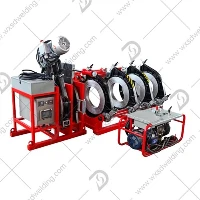
Hey there! As a supplier of workshop welding machines, I often get asked if these machines can be used for precision welding. Well, let's dive right into it and explore this question together.
First off, what exactly do we mean by precision welding? Precision welding involves joining materials with a high degree of accuracy, usually with tight tolerances on things like joint alignment, weld bead size, and heat - affected zone. It's commonly used in industries such as aerospace, electronics, and medical device manufacturing, where even the slightest deviation can lead to product failure.
Now, workshop welding machines come in a variety of types, each with its own set of capabilities. There are MIG (Metal Inert Gas) welders, TIG (Tungsten Inert Gas) welders, stick welders, and more.
Let's start with MIG welders. These are pretty popular in workshops. They're known for their speed and ease of use. MIG welders work by feeding a continuous wire electrode through a welding gun, and an inert gas shields the weld pool from contamination. For precision welding, MIG welders have some pros and cons. On the plus side, modern MIG welders often come with adjustable settings for voltage, wire feed speed, and gas flow rate. This allows you to fine - tune the welding process to some extent. For example, if you're working on thin materials, you can lower the voltage and wire feed speed to create a smaller, more precise weld bead.
However, MIG welding does have its limitations when it comes to precision. The high deposition rate can sometimes make it difficult to control the weld pool, especially in tight spaces or when working on complex geometries. Also, the arc can be a bit more spread out compared to other welding processes, which might not be ideal for applications where you need to focus the heat precisely.
TIG welders, on the other hand, are often considered the go - to choice for precision welding. With TIG welding, a non - consumable tungsten electrode is used to create the arc, and a separate filler metal can be added if needed. The use of a foot pedal to control the amperage gives the welder a high level of control over the heat input. This is crucial for precision welding because it allows you to make very small, controlled adjustments to the welding process.
For instance, in the aerospace industry, TIG welding is used to join thin aluminum components. The ability to precisely control the heat means that you can avoid warping or over - heating the material, which could compromise the structural integrity of the part. Our Straight Tube Butt Welding Machine can be used in TIG welding setups, and it provides a stable platform for joining tubes with high precision.
Stick welders are another type of workshop welding machine. They're simple, robust, and can be used in a variety of environments. Stick welding uses a consumable electrode coated in flux. While stick welding is great for heavy - duty applications and outdoor work, it's not typically the first choice for precision welding. The flux coating creates a lot of slag, which can be difficult to control, and the arc can be a bit more erratic compared to MIG or TIG welding.
But that doesn't mean workshop welding machines can't be adapted for precision welding. With the right setup and technique, you can achieve a high level of precision even with a standard workshop welder. For example, using fixtures and jigs can help hold the workpieces in place and ensure proper alignment. This is especially important when welding parts that require a high degree of accuracy.


In the pipe - fitting industry, precision is key. Our Butt Weld Pipe Fitting Supplier offers a range of products that can be welded with our workshop welding machines. Whether it's joining pipes for plumbing systems or industrial pipelines, having a precise weld is essential to prevent leaks and ensure the long - term performance of the system.
Let's also talk about plastic welding. Our Automatic Plastic Pipe Welding Machine is designed for precision welding of plastic pipes. Plastic welding requires a different approach compared to metal welding. The heat input needs to be carefully controlled to melt the plastic without causing it to degrade. This machine uses advanced heating elements and control systems to ensure that the welding process is consistent and precise.
One important factor to consider when using workshop welding machines for precision welding is the quality of the equipment. Investing in a high - quality welder with good control features can make a big difference. Also, regular maintenance of the welding machine is crucial. Things like cleaning the electrodes, checking the gas connections, and calibrating the settings can all contribute to better precision.
Another aspect is the skill of the welder. Even the best welding machine won't produce precise welds if the operator doesn't know how to use it properly. Training and experience are essential. A skilled welder can adjust the welding parameters on the fly based on the material, thickness, and joint design.
In conclusion, while workshop welding machines might not be as specialized as some industrial - grade precision welding equipment, they can definitely be used for precision welding with the right approach. Whether you're a small - scale manufacturer, a hobbyist, or a professional welder, there are ways to achieve high - quality, precise welds using our workshop welding machines.
If you're interested in learning more about how our workshop welding machines can meet your precision welding needs, or if you're ready to start a procurement discussion, feel free to reach out. We're here to help you find the right solution for your welding projects.
References
- "Welding Handbook" published by the American Welding Society
- Various industry whitepapers on welding techniques and precision requirements.